
There’s something about National Treasure that makes it a perfect movie to revisit as America celebrates its 250th birthday. It has adventure. It has mystery. It has American history woven throughout the storyline. It has a race to protect something priceless before it falls into the wrong hands. But underneath the treasure map, the hidden clues, and the chase scenes, there’s a leadership lesson worth paying attention to: Some things are valuable not because they are obvious, but because someone understands their meaning.
That’s true of history.
That’s true of legacy.
And it’s absolutely true of culture.
In National Treasure, Benjamin Gates believes there is something worth finding, worth protecting, and worth preserving. Not everyone agrees with him. Some people think he’s chasing a myth. Others want the treasure for selfish reasons. But Ben sees more than artifacts and clues. He sees a story that matters.
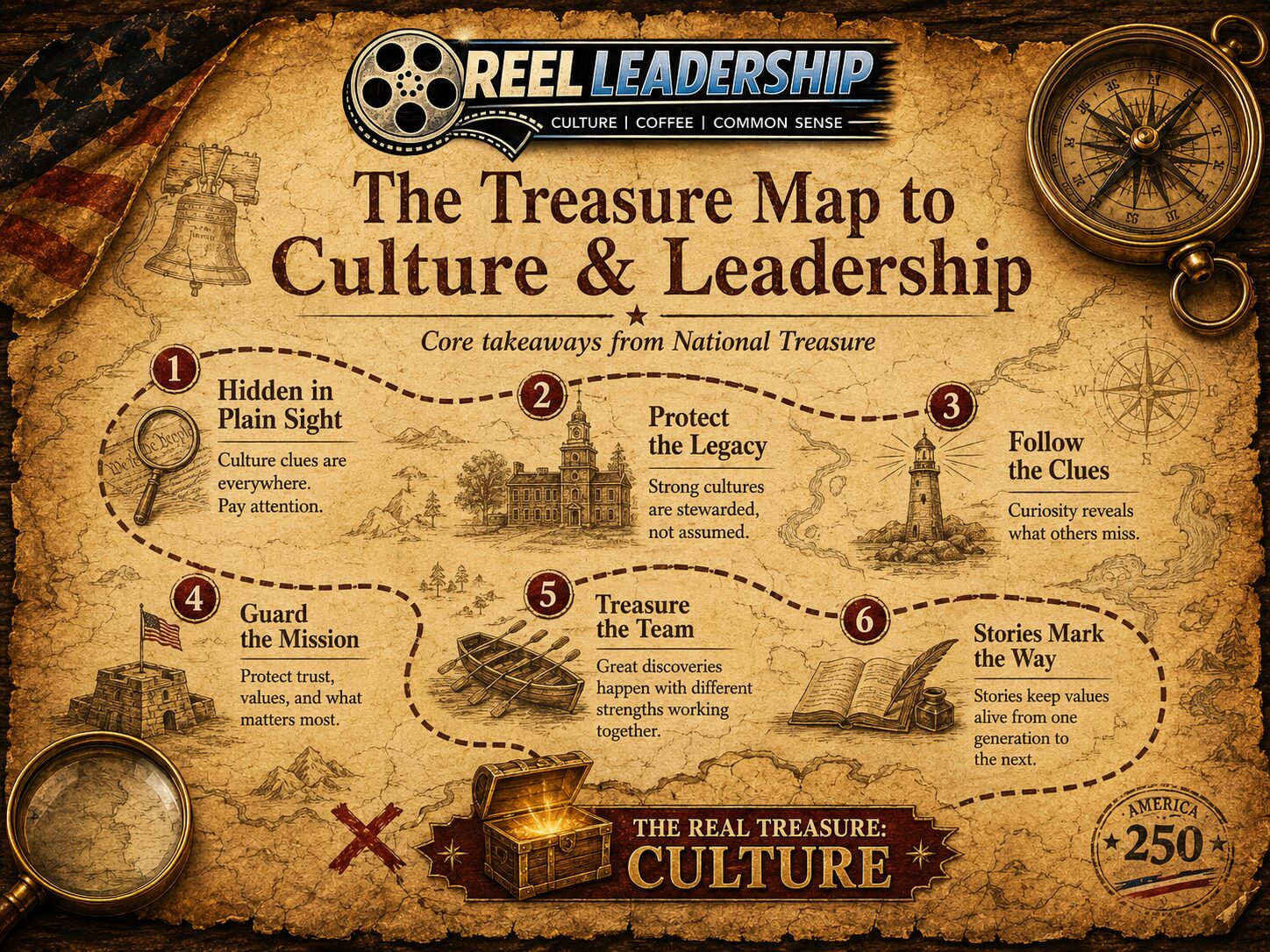 That’s where the culture lesson begins. Because inside every organization, there are treasures too. They may not be hidden behind a brick wall or marked by a secret symbol. They may not come with a map or a dramatic soundtrack. But they are there.
- Trust.
- Values.
- Reputation.
- Institutional knowledge.
- Stories of people who went above and beyond.
- Customer and member relationships built over years.
- The little traditions that make people feel like they belong.
- The standards that remind everyone, “This is who we are.”
Those things are easy to take for granted. They are also easy to lose if leaders don’t treat them like something worth protecting.
Culture Is Hidden in Plain Sight
One of the things I love about National Treasure is how the clues are often right in front of people. They walk past them. They overlook them. They don’t recognize their significance.
Until someone looks closer.
Culture works the same way.
It’s hidden in plain sight every single day. You can see it in how people greet each other in the hallway. You can hear it in the way teams talk about customers, members, clients, or one another. You can feel it in a meeting when someone shares an idea and either gets encouraged or shut down.
Culture is in what gets celebrated. It’s in what gets ignored. It’s in how leaders respond when something goes wrong. It’s in whether people feel safe enough to tell the truth before a small issue becomes a big problem.
The challenge is that leaders often miss these clues because they are moving too fast. They are focused on the next report, the next deadline, the next project, or the next crisis. But culture leaves clues everywhere.
The question is whether we’re paying attention.
Legacy Requires Stewardship
Ben Gates doesn’t view history as something dusty or irrelevant. He treats it as something living. Something entrusted to him. Something that must be protected and passed on.
That word matters: entrusted.
Leaders are entrusted with culture.
Whether you lead a company, a department, a team, a classroom, a boardroom, or a community organization, you are carrying something you didn’t build alone. Others came before you. They made decisions, solved problems, created traditions, built relationships, and left behind a reputation.
Some of that legacy may be beautiful.
Some of it may need to be challenged.
Some of it may need to be restored.
But none of it should be ignored.
As America celebrates 250 years, it’s natural to think about legacy on a national scale. What have we inherited? What are we grateful for? What still needs care, courage, and attention? What do we want to pass forward?
Those same questions belong inside organizations.
- What did we inherit?
- What are we protecting?
- What needs to be repaired?
- What do we want the next generation of employees, leaders, customers, and communities to say about us?
Culture doesn’t stay strong because someone wrote values on a wall. It stays strong because leaders choose to steward it on purpose.
Curiosity Reveals What Others Miss
Ben’s greatest advantage isn’t just knowledge. It’s curiosity. He asks questions. He follows patterns. He connects details others dismiss. He believes there is more to the story than what appears on the surface.
That kind of curiosity is one of the most underrated leadership skills. Curious leaders don’t settle for “that’s just how we do things here.”
They ask:
- Why do we do it this way?
- What are we missing?
- Who hasn’t been heard?
- What is the pattern behind this problem?
- What does this frustration reveal about our culture?
- What story are people telling themselves about this decision?
Curiosity helps leaders find the real issue instead of just reacting to the loudest symptom.
A team that seems resistant may actually be confused.
An employee who seems disengaged may feel overlooked.
A customer complaint may point to a process problem.
A communication breakdown may reveal that people don’t have the context they need.
Curiosity is how leaders uncover the truth before it becomes costly.
Protecting the Mission Takes Courage
In the movie, Ben believes something priceless is at risk. Whether everyone agrees with his methods or not, his motivation is protection. He sees danger before others do, and he acts because the stakes are too high to ignore.
In leadership, protecting the mission also takes courage.
It takes courage to speak up when values are being compromised.
It takes courage to address behavior that is damaging the team.
It takes courage to say, “This is not who we are.”
It takes courage to slow down and fix a process instead of pretending everything is fine.
It takes courage to protect trust before it erodes.
Strong leaders don’t wait until culture is in crisis before they pay attention. They notice the warning signs. They listen to the quiet clues. They step in before the damage becomes part of the norm. Because once trust is lost, it takes a lot longer to rebuild than it would have taken to protect.
The Best Discoveries Happen With a Team
Ben may be the believer and the driver of the mission, but he doesn’t do it alone.
Riley brings humor, technology, and a different way of thinking. Abigail brings expertise, credibility, and perspective. Each person sees something the others might miss.
That is such a good reminder for leaders.
The best teams are not made up of people who all think alike. They are made up of people with different strengths who are committed to the same mission. A healthy culture makes room for those differences.
- It allows the analytical person to ask hard questions.
- It allows the creative person to see new possibilities.
- It allows the relational person to notice how people are feeling.
- It allows the detail-oriented person to catch what others overlook.
Great leaders don’t have to be the only genius in the room. They have to create a room where everyone’s genius can show up.
Stories Keep Values Alive
One of the most meaningful parts of National Treasure is the relationship between Ben and his father.
Patrick Gates has lived with the weight of the family story. He knows what it is like to believe in something and be disappointed by it. He is skeptical, protective, and at times frustrated by Ben’s determination. But underneath that tension is something familiar to many of us: the complicated way family shapes what we believe, what we chase, and what we refuse to let go of.
That part of the movie resonates with me.
My readers and audiences have heard me talk about my dad many times. He shaped so much of who I am. I watched him use his creativity in ways that were different from mine, but deeply inspiring to me. I watched how he treated customers more like family than clients. I saw the business side of business by sitting nearby and helping in small ways. I learned from his work ethic, his care for people, his creativity, and the way he made me feel loved and supported.
Those stories still influence how I lead, how I communicate, how I teach, and how I think about culture.
That’s the power of story.
Stories carry values from one generation to the next.
Organizations have stories too. Stories about the employee who stayed late to solve a customer issue. Stories about the team that pulled together during a storm, a crisis, or a difficult season. Stories about a leader who chose people over ego. Stories about a moment when the organization did the right thing even when it wasn’t the easiest thing.
When leaders tell those stories, they remind people what matters. When they stop telling them, the culture starts to forget.
Not Everything Valuable Looks Valuable at First
In National Treasure, a clue can look ordinary until someone understands the context.
That happens in organizations all the time.
A long-time employee’s knowledge may not seem urgent until they retire and take decades of experience with them. A small tradition may not seem important until it disappears and people feel the loss. A quiet team member’s idea may not seem groundbreaking until someone takes the time to listen. A core value may seem like a phrase until a hard decision proves whether it is real.
Leaders have to learn to recognize value before it disappears. That means paying attention to people, stories, habits, and traditions that may seem ordinary but are actually holding the culture together.
The Real Treasure Is Culture
National Treasure works because it reminds us that meaning matters.
The treasure is not just about gold or artifacts. It’s about history, identity, sacrifice, belief, and responsibility. It’s about recognizing that some things are too important to neglect, misuse, or forget.
That’s the leadership lesson.
Culture is one of the greatest treasures a leader is trusted to protect. Not because it is fragile, but because it is valuable. America’s 250th anniversary invites us to think about the treasures we’ve inherited as a country — freedom, courage, resilience, innovation, and the belief that ordinary people can build something extraordinary.
The same is true inside our organizations.
Every team has treasures worth protecting: trust, purpose, values, relationships, reputation, and the stories that remind people why the work matters.
The real question for leaders is this:
Are you treating your culture like something worth preserving — or assuming it will protect itself?
Because culture doesn’t protect itself.
People do.
And the best leaders are the ones who recognize the treasure before it’s lost.
 Want more practical leadership insights like this delivered straight to your inbox?
Grab a cup of coffee and join me for Culture, Coffee & Common Sense. Delivered bi-weekly. Always thoughtful. Never overwhelming.
👉 https://chelliephillips.com/culture-coffee-commonsense/
 If you want more secrets to a thriving workplace, you can:
See why The Hollywood Magazine put Culture Secrets is on it’s must read list in 2025.
Listen to the Culture Secrets Podcast on your favorite platform.
Grab your copy of the book Culture Secrets.
Booking now for speaking and training events.
Check out my audio books: Get Noticed, Get Hired or When In Doubt, Delete It!