
By late August, I can feel the tide of excitement rising—and yes, that pun was absolutely intended.
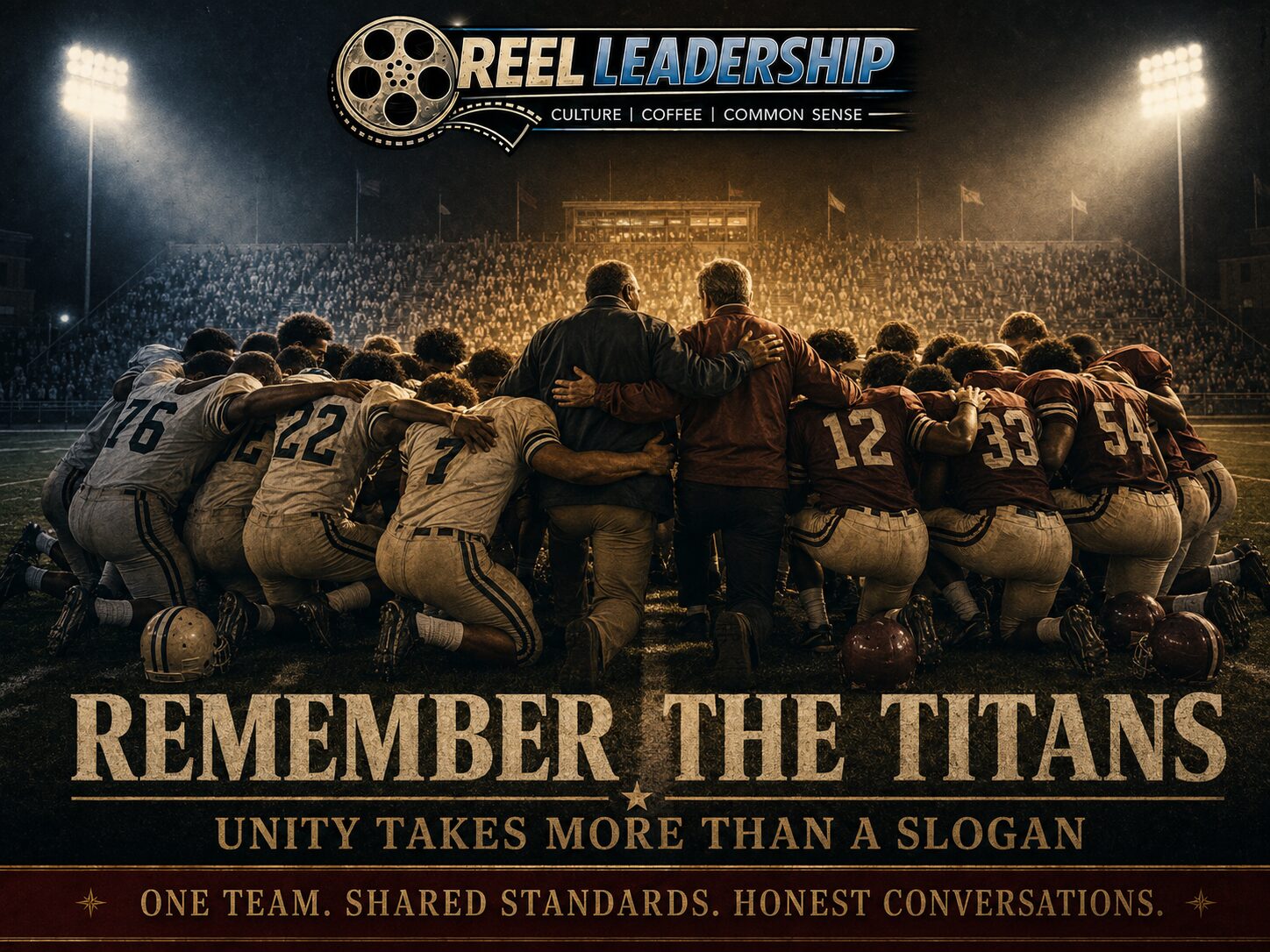
Unity takes more than a slogan. Remember the Titans reminds leaders that trust, shared standards and honest conversations turn a group into a team.
High school stadium lights are coming back on. College football predictions are everywhere. Fans are pulling out their favorite shirts, planning game-day menus and convincing themselves that this is definitely going to be their team’s year.
As a lifelong Roll Tide Bammer, I understand football loyalty. And just so we’re clear, I didn’t become an Alabama fan during the Saban years when championships made wearing crimson especially fun. I’ve loved Alabama football through the good years, the difficult years, the legendary coaches, the coaching searches and the Saturdays when the scoreboard tested both my loyalty and my ability to communicate calmly.
Real fans don’t disappear when the season gets hard.
Come to think of it, neither do real leaders.
That makes the end of August the perfect time to revisit Remember the Titans—a movie about football, certainly, but even more about culture, courage and what it takes to turn people who share a uniform into people who trust one another.
The film follows a newly appointed Black head coach and a high school team navigating its first season as a racially integrated unit in 1970s Virginia. The players arrive with talent, assumptions, anger, fear and very little interest in becoming one team. Disney’s synopsis captures that central conflict.
They may be called the Titans, but a shared name does not automatically create a shared identity.
That is where the leadership lessons from Remember the Titans begin.
Wearing the Same Uniform Doesn’t Make You a Team
Organizations often confuse proximity with unity.
People may work in the same building, wear the same logo and appear on the same organizational chart while operating as completely separate groups.
Departments protect their own information. Longtime employees distrust new hires. Frontline teams believe leadership is disconnected. Employees sit through a meeting together, nod in agreement and then return to entirely different interpretations of what was decided.
That isn’t one team. It is a collection of people wearing the same uniform.
In Remember the Titans, Coach Boone understands that running the same plays will not be enough. The players must learn about one another. They have to move beyond labels, assumptions and the stories they have already decided are true.
Leaders cannot manufacture trust with a slogan, a team-building lunch or matching shirts.
Trust grows when people know one another, work through discomfort and discover that the person they dismissed may bring something valuable to the field.
Honest Conversations Come Before Real Unity
It would be easy—and wrong—to reduce the movie’s conflict to a simple communication problem. The players and community are confronting racial prejudice, resentment and deeply rooted division.
The film doesn’t suggest that those issues disappear because everyone agrees to focus on football.
The players are forced into proximity, but relationships begin to change only when they start having honest conversations. They challenge one another. They listen. They argue. They recognize their own assumptions. Slowly, they begin to see people where they once saw only categories.
Workplace cultures also become unhealthy when leaders prioritize surface-level peace over honest conversation.
Silence may make a meeting more comfortable, but it does not make a team more united.
Sometimes leadership means lowering the temperature so people can talk honestly. Sometimes it means naming the division everyone else is carefully avoiding. And sometimes it means listening long enough to understand why two groups can experience the same workplace very differently.
Unity is not the absence of disagreement.
It is the decision to keep working toward a shared purpose even when the conversation is uncomfortable.
Shared Standards Build Trust
Coach Boone and Coach Yoast have different personalities, different methods and plenty of reasons to distrust each other.
But the team needs both of them.
The turning point does not come when one coach becomes exactly like the other. It comes as they learn to respect what the other contributes and place the team’s success above their own pride, position and recognition.
That is an important distinction for leaders.
Unity does not require sameness. Strong cultures make room for different experiences, strengths and perspectives while holding everyone to shared standards.
Accountability cannot depend on who someone knows, how long they have worked there, which department they represent or whether the leader personally likes them.
People watch to see whether expectations apply fairly. When standards change based on the person involved, trust disappears quickly.
A team becomes stronger when people know the mission is shared, the expectations are clear and everyone is responsible for the culture being created.
Culture Changes When Peer Leaders Step Up
Coaches can establish expectations, but they cannot create the entire culture from the sideline.
The relationship between Gerry Bertier and Julius Campbell becomes central to the Titans’ transformation. They begin on opposite sides of the team’s division. Over time, they challenge each other, respect each other and begin holding their teammates accountable to something bigger than personal comfort.
That is when the culture truly begins to shift.
Every workplace has peer leaders—people whose influence is not dependent on a title. Their reactions can strengthen a new direction or quietly undermine it. They can invite someone into the group or make it clear that the person will never fully belong.
Formal leaders should pay attention to those influencers.
Who do people watch before deciding how to respond? Who can calm a frustrated group? Who gives others permission to try something new? Who reinforces the values when management is not in the room?
Culture becomes sustainable when leadership is practiced throughout the team, not reserved for the people with titles.
The Championship Is the Result—Not the Culture
Football makes it easy to measure success. The scoreboard gives us an answer.
Workplace culture is not always that obvious.
The real victory in Remember the Titans is not simply winning games. It is watching people who entered the season divided learn to trust, challenge, protect and believe in one another.
The wins are the result. The relationships are the transformation.
That aligns with every part of the V.A.L.U.E. Culture Formula: a shared Vision, fair Accountability, courageous Leadership, respect for each person’s Uniqueness and genuine Engagement that gives people a role in building the team.
A winning season is exciting. Ask any Alabama fan. We do enjoy a full trophy case.
But leadership is revealed in what happens when the season is difficult, the pressure rises and the easy wins stop coming.
Do people turn on one another—or toward one another?
That is the real culture test.
Your Leadership Huddle
Before the next kickoff, consider three questions:
- Where are people in my organization wearing the same uniform but operating as separate teams?
- What honest conversation are we avoiding because surface-level peace feels easier?
- Which peer leaders could help us build greater trust, accountability and belonging?
You cannot win as a team if you refuse to become one.
That is true on Friday nights, Saturday afternoons and every Monday morning when people return to work.
And whether your colors are crimson and white—or even orange and blue, although bless your heart—the leadership lesson remains the same:
Unity takes more than a slogan. It takes relationships, shared standards, honest conversations and leaders willing to stay committed through the good seasons and the hard ones.
 If you enjoyed this REEL LEADERSHIP moment, you may also enjoy:
Reel Leadership: Dead Poets Society and the Leadership Lessons We Need to Relearn
National Treasure and the Culture Worth Protecting
E.T. and the Leadership Power of Belonging
 Want more practical leadership insights like this delivered straight to your inbox?
Grab a cup of coffee and join me for Culture, Coffee & Common Sense. Delivered bi-weekly. Always thoughtful. Never overwhelming.
👉 https://chelliephillips.com/culture-coffee-commonsense/
 If you want more secrets to a thriving workplace, you can:
See why The Hollywood Magazine put Culture Secrets is on it’s must read list in 2025.
Listen to the Culture Secrets Podcast on your favorite platform.
Grab your copy of the book Culture Secrets.
Booking now for speaking and training events.
Check out my audio books: Get Noticed, Get Hired or When In Doubt, Delete It!