
I was having breakfast at a little café recently when I noticed Looney Tunes playing on the television.
It had probably been years since I’d watched Bugs Bunny and the gang, but it didn’t take long before I was completely sucked in. There’s just something about those old cartoons. The elaborate schemes. The perfect timing. The anvils falling from the sky. The characters who could be flattened by a steamroller in one scene and return completely unharmed in the next.
Watching them that morning reminded me why I’ve always loved them.
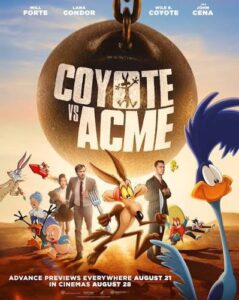 With the new Coyote vs. Acme movie bringing the characters back into the spotlight, it also got me thinking about what those Saturday morning cartoons may have been teaching us all along. And once I started looking, the Looney Tunes leadership lessons were everywhere.
I’m not suggesting Bugs Bunny was secretly designed to be an executive coach. But when you look at these characters through an adult lens, you begin to recognize a few familiar personalities.
We’ve worked with a Foghorn Leghorn who never stopped talking long enough to hear anyone else. We’ve watched someone pull a Wile E. Coyote and invest in one more expensive tool instead of reconsidering the plan. And if we’re honest, most of us have had at least one Daffy Duck moment when comparison got the best of us.
Perhaps there was more leadership wisdom hiding behind those ACME crates than we realized.
Bugs Bunny: Stay calm and adapt
Bugs Bunny rarely begins with the advantage. 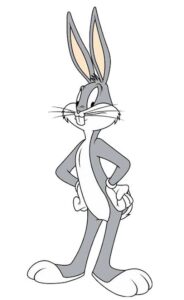
Someone is usually hunting him, chasing him or interrupting an otherwise peaceful day. But while everyone around him becomes increasingly frustrated and frantic, Bugs stays calm.
He pays attention. He reads the situation. Then he adapts.
Bugs doesn’t need the original plan to work because he is confident he can come up with another one. He understands the personalities around him and uses that knowledge to determine his next move. While his opponent is reacting emotionally, Bugs is thinking strategically.
That ability matters in leadership.
The best leaders aren’t necessarily the ones who can predict everything that will happen. They’re the ones who remain steady enough to respond when something unexpected does.
They don’t allow someone else’s urgency to become their panic. They don’t become so attached to the original plan that they miss the better option appearing in front of them.
Calm is not the absence of action. Sometimes it is what allows us to see the right action.
And Bugs could remain calm in almost any situation.
What’s up, Doc?
Daffy Duck: Comparison can make you forget what you bring to the show
Daffy is talented, funny and completely unforgettable.
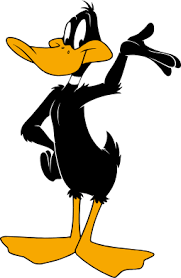 Unfortunately, he often forgets that the moment Bugs Bunny enters the picture.
Standing next to Bugs brings out Daffy’s insecurity. Instead of leaning into what makes him distinctive, he becomes consumed with proving that he deserves the same attention, admiration or starring role Bugs receives.
His desire to outshine Bugs usually keeps Daffy from being his best.
That’s what comparison does to us.
It shifts our attention away from developing our own strengths and toward resenting someone else’s. We start measuring our success against their applause, title, opportunity or visibility. Before long, we’re performing for recognition instead of contributing from a place of confidence.
Strong leaders can appreciate someone else’s gifts without treating them as a threat. They understand that recognizing another person’s value does not diminish their own.
There is room for Bugs Bunny and Daffy Duck in the same show.
The same is true for us.
Wile E. Coyote: Persistence needs reflection
You have to admire Wile E. Coyote’s commitment.
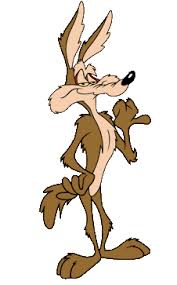 No matter how many plans fail, cliffs collapse or rockets send him in the wrong direction, he gets up and tries again. That kind of resilience is valuable.
But Wile E. has one significant weakness: He rarely stops to evaluate why the plan failed.
Instead, he places another order with ACME.
A bigger catapult. A more complicated trap. A newer gadget. A more elaborate solution.
Surely the next tool will finally produce the result he wants.
There’s a lesson in that for today’s workplace—especially as we’re surrounded by new technologies and tools promising to make us faster, smarter and more effective.
A new tool can support a good strategy. It cannot rescue a flawed one.
Persistence is admirable, but repeating the same basic approach with more sophisticated equipment isn’t necessarily innovation. Sometimes it’s simply a more expensive way to stay stuck.
Good leaders know when to keep going, but they also know when to pause and ask:
What did we learn?
What are we missing?
Is the plan still sound?
What needs to change before we try again?
Determination keeps us moving. Reflection helps us move in a better direction.
The Road Runner: You don’t have to attend every argument you’re invited to
While Wile E. Coyote builds increasingly complicated traps, the Road Runner does something remarkably consistent.
He keeps moving. 
He doesn’t stop to explain himself. He doesn’t defend his speed or debate the Coyote’s intentions. He doesn’t abandon his destination to get drawn into someone else’s drama.
He stays in his lane and continues down the road.
Leaders can lose an enormous amount of time and energy responding to every distraction, criticism and invitation to engage. We feel compelled to correct every misunderstanding, answer every comment or prove that someone else is wrong.
Not every situation requires our participation.
That doesn’t mean we ignore legitimate concerns or avoid necessary conversations. It means we learn to distinguish between an issue that deserves our attention and a distraction that simply wants it.
Sometimes the best response is to remain focused on where you’re going.
Meep meep.
Marvin the Martian: Never mistake quiet for insignificant
Marvin the Martian may be one of the softest-spoken characters in the Looney Tunes universe.
He is polite. Controlled. Almost understated. 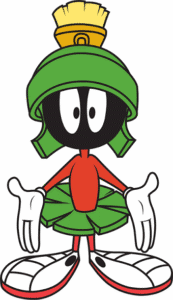
He is also frequently planning something with planetary consequences.
Marvin reminds us not to confuse volume with influence.
In workplaces, the loudest voices often receive the most attention. The people who speak first, speak often or speak with the greatest confidence can easily dominate a conversation. Meanwhile, quieter employees may be observing details, identifying risks or developing ideas no one else has considered.
Silence doesn’t always signal agreement. A reserved personality doesn’t indicate a lack of passion. And the person saying the least may still be thinking the most.
Good leaders make room for voices that don’t fight to be heard.
They ask for input before assuming everyone agrees. They create more than one way for people to contribute. And they pay attention to the person who looks as if they might have something to say but hasn’t found the opening.
You don’t have to be loud to have an earth-shattering idea.
Foghorn Leghorn: Talking is not the same as communicating
“I say, I say…”
Foghorn Leghorn has never suffered from a shortage of words.
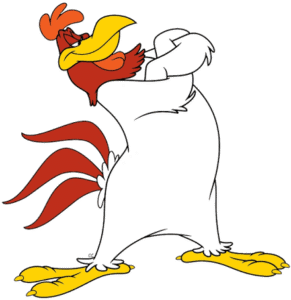 He is confident, opinionated and always prepared to explain what everyone else should be doing. But he isn’t nearly as enthusiastic about listening.
We’ve all encountered a Foghorn Leghorn.
He’s the person who dominates the meeting, interrupts the answer to his own question and mistakes having the most to say for having the most influence.
But communication is not measured by how long we talk. It’s measured by what others understand and whether they believe their voices matter, too.
Leaders sometimes overcommunicate in one direction while undercommunicating in every other one. They give instructions, deliver updates and repeat key messages, yet never create space for questions, concerns or ideas.
If people leave a conversation knowing what the leader thinks but feeling that the leader has no idea what they think, communication hasn’t really occurred.
Strong communicators don’t merely hold the floor.
They know when to give it away.
Elmer Fudd: Fixation creates tunnel vision
Elmer Fudd becomes so focused on catching Bugs Bunny that Bugs often controls the entire encounter.
Everything else disappears. Elmer’s attention narrows until the pursuit is all he can see. And because Bugs understands that fixation, he can lead Elmer almost anywhere.
Leaders can develop the same kind of tunnel vision. 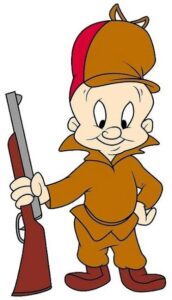
We become consumed by one problem, competitor, metric or outcome. We keep chasing it long after the pursuit begins costing more than the potential result. Other priorities receive less attention. New information gets overlooked. Opportunities pass by because they don’t look like the thing we decided we needed.
Focus is valuable. Fixation is different.
Focus helps us direct our energy toward what matters. Fixation prevents us from noticing when something else matters more.
Every now and then, leaders need to step back from the hunt, look around and make sure the pursuit hasn’t taken control of the person doing the pursuing.
Sylvester and Tweety: Power isn’t always where it appears to be
At first glance, Sylvester appears to hold all the power.
He is larger. Stronger. More intimidating. Tweety is tiny, physically vulnerable and seemingly trapped.
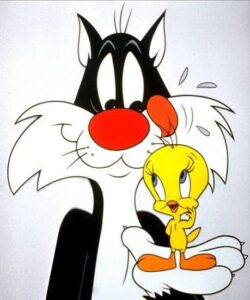 Yet we know how the story usually ends.
Tweety pays attention. He recognizes danger early. He understands his environment and knows when to enlist the help of an ally—usually in the form of Granny or one very large bulldog.
“I tawt I taw a puddy tat.”
Tweety reminds us that authority, influence and capability aren’t always found in the biggest personality or the most impressive title.
People who appear to have less formal power may possess stronger relationships, deeper institutional knowledge or a better understanding of what is actually happening. They may notice risks long before senior leaders do.
Titles tell us where someone sits on an organizational chart. They don’t tell us everything that person knows, sees or can contribute.
Never underestimate the smallest voice in the room.
Speedy Gonzales: Urgency should have a purpose
Speedy Gonzales is fast, but speed alone isn’t what makes him effective.
He usually has somewhere to go, a problem to solve or someone to help. His movement has purpose. 
There is an important difference between creating urgency and simply making everyone feel rushed.
Some workplaces operate as though every request is an emergency. Priorities change without warning. Deadlines appear with no explanation. People move quickly but don’t always know whether their activity is producing anything valuable.
Eventually, constant urgency becomes noise.
Effective leaders help people understand not only that something needs to happen quickly, but why it matters. They clarify the destination, remove unnecessary obstacles and make sure the team isn’t exhausting itself racing in circles.
Speed can create momentum.
But only direction turns that momentum into progress.
Pepé Le Pew: Read the room—and know when to move on
Pepé Le Pew never lacks confidence or commitment.
Once he decides what he wants, he pursues it with complete certainty. The problem is that he becomes so focused on the outcome that he misses every signal telling him it may be time to change direction. 
Persistence can be a tremendous strength. Leaders need the ability to stay committed when something is difficult, when progress is slow and when others have yet to see what is possible.
But persistence without awareness can keep us chasing an idea, opportunity or outcome long after it has stopped making sense.
Sometimes it’s a proposal no one is willing to support. Sometimes it’s an initiative that has outlived its usefulness. Sometimes it’s a potential client who simply isn’t interested. And sometimes it’s a door that remains closed because it isn’t ours to walk through.
Strong leaders read the room.
They pay attention to the signals they receive. They know the difference between an obstacle worth overcoming and an answer they don’t want to accept.
Sometimes resilience means trying again.
Sometimes wisdom means moving on.
Maybe we saw ourselves in them all along
Maybe that’s why these characters still work after all these years.
Beneath the disguises, falling anvils and malfunctioning ACME products, they remind us of people we know—and occasionally, if we’re honest, the people we become.
Some days we’re Bugs, staying calm and finding another way.
Some days we’re Daffy, allowing comparison to make us forget what we bring to the show.
Some days we’re Wile E., ordering one more solution without reconsidering the plan.
And some days we’re Foghorn Leghorn, still talking long after we should have started listening.
Those old cartoons made us laugh because the characters were exaggerated. But exaggeration has a way of helping us recognize the truth.
Perhaps the best leadership lesson from the Looney Tunes gang is that every strength has another side. Confidence can become ego. Persistence can become stubbornness. Focus can become fixation. Urgency can become chaos.
Leadership requires enough self-awareness to recognize when we’ve crossed that line—and enough humility to make a change.
 That’s all, folks.
Although the leadership lessons, it seems, are still playing.